Hebrew has seven forms of verbs, called “Binyamin”. Each “Binyan” portrays an aspect of the root (“SHORESH”). Binyan literally means “building” or “structure”.
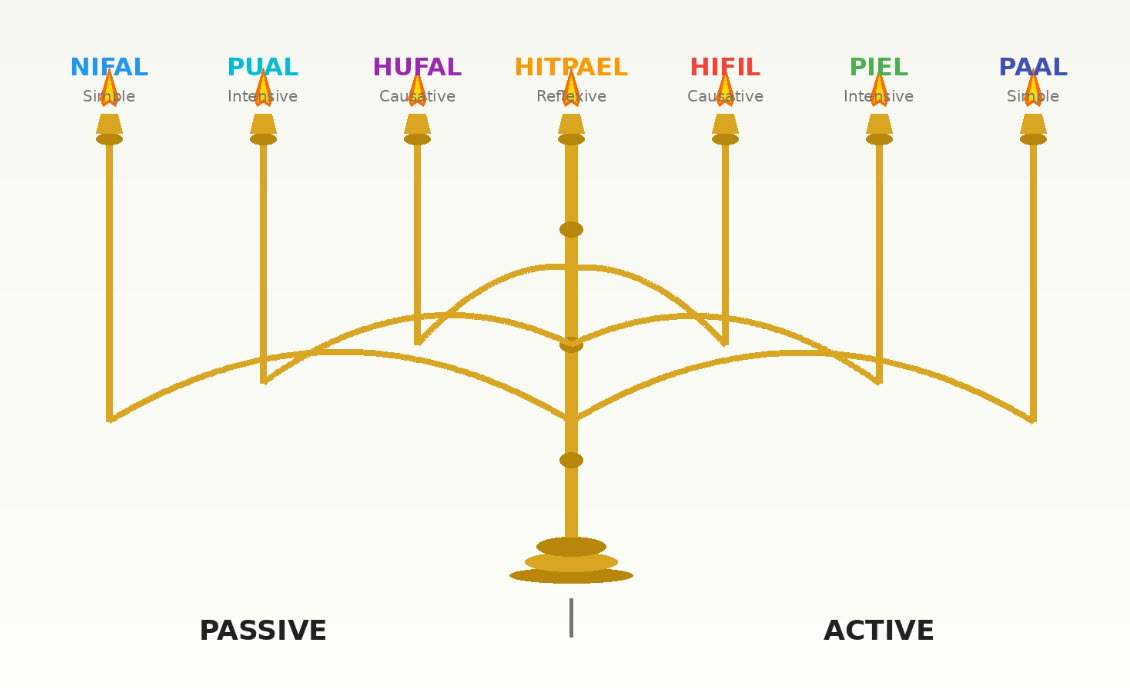
In the table below, we sill take the root “KATAV” through all seven binyanim. Each binyan actually has a perfect and imperfect tense (which roughly correlates with past and future). Not all verbs fit in all seven binyanim.
Shoresh/Root word:
orWhen you look up a verb in a Hebrew dictionary, use use the third person masculine PAAL (QAL=simple) form.
| # | Binyan | Simple | Voice | Sample Verb from the “KTV” root | Meaning | Binyan |
|---|---|---|---|---|---|---|
| 1 | NIFAL | Simple | Passive | It was written | ||
| 2 | PUAL | Intensive | Passive | It was engraved | ||
| 3 | HUFAL | Causative | Passive | It was dictated | ||
| 4 | HITPAEL | Reflexive (or cooperative) | N/A | He corresponded | ||
| 5 | HIFIL | Causative | Active | He dictated | ||
| 6 | PIEL | Intensive | Active | He engraved | ||
| 7 | PAAL (or QAL) | Simple (light) | Active | He wrote |